Monday, November 24, 2014

Nov 24th: Hi & Lois – Trolls

Hello everyone!

Today’s comic is Hi & Lois featuring a cultural lesson on a popular toy in North America.


COMIC BREAKDOWN

Then (the past)
“This Troll collection will be worth a fortune someday!” – Hi to his daughter

Now (the present)
“How much for the Trolls?” – Woman

“A buck.” – Hi

What is a buck?

A “buck” is a slang (casual/informal word) for dollar.  

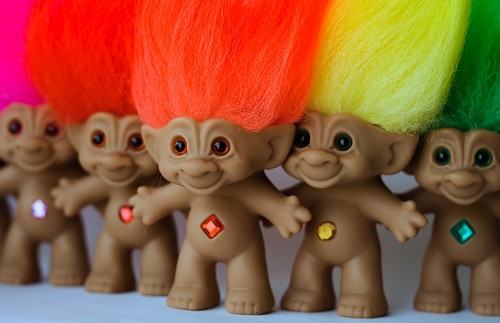
What is a Troll?

Troll dolls were a popular toy in North America in the early 1960s and again in the 1970s, 1980s, and finally from the early to mid – 1990s.


Troll dolls originated from Denmark in 1959 when the Danish woodcutter, Thomas Dam, first started making them.  Another name for Troll dolls is Dam dolls. 

Troll dolls were a very popular fad.  A “fad” is something that is seen as uncommon yet cool and as a result gets a lot of popular attention for a short time.  Troll dolls gained a lot of popularity because instead of being cute, the way most toys are, it is considered ugly by most people.  Some people would say that the Troll doll is an example of something that is so ugly that it is cute! 

Cultural Importance

Today, the Troll doll represents a popular toy of the past.  It is a toy that many generations of North Americans recognize or owned in their childhood. 


Why is this comic funny?

Troll dolls made in the 1960s are worth a lot of money today.  Collectors will pay a lot of money for them.

Trolls dolls made after the 1960s and especially those from the 1990s are not worth much at all.  Many North American families have lots of Troll dolls from the 1990s so they are common and easy to buy for very little money.


In conclusion, this comic is funny because it shows how people will buy and collect things when they are popular, such as toys, believing that they will make a lot of money selling them one day.  But most of the time, items from popular fads will not be worth anything in the future.

Today’s images are from here, here, here, and here.

Friday, November 21, 2014

Nov 21st: Family Circus – Dawdling

Hello everyone!

Today’s comic is a Family Circus. 


COMIC BREAKDOWN

“Hurry up, Jeffy! You’re being a dawdler!” – Thelma to her son Jeffy

“No, I’m being a son.” – Jeffy responding to his mother. 

What is a dawdler?

A dawdler (noun) is someone that is moving or acting slowly.  A dawdler may or may not be acting slow on purpose but people think they can be faster.

The word “dawdler” comes from the word “dawdle” (verb).  The word dawdle means more than just being simply slow.  It means acting or taking more time than needed to complete something. 

Synonyms for Dawdle/Dawdler – words with the same or similar meaning


Dawdle (verb) – linger, lag, loiter, idly, and delay

Dawdler (noun) – snail, lagger, lingerer, idler, procrastinator, straggler

Slangs for dawdler include “slow poke” and “time waster”.

Why is this funny?


Thelma is trying to tell her son, Jeffy, to hurry up because he is being too slow. 

Calling someone a “dawdler” is a polite and annoyed way to speak to someone that is being slow without literally telling them to “hurry up!”  Parent’s commonly call their young children “dawdlers”.

Jeffy misunderstood the noun “dawdler” by taking it literally and wastes even more time by telling his mother he is not a dawdler but he is a son (someone’s child). 

His response could be a way for a smart child to be literal or to be rude in a smart way by answering back to his parent.  The expression would be that Jeffy was “being smart” to his mother. 

Regardless, calling someone a “dawdler” either leads to confusion or more annoyance so the result is usually more time gets wasted. 

Today’s images are from here, here, here, here, and here.

Monday, November 17, 2014

Nov 16th: Family Circus – Mispronunciation & Malapropism

Hello everyone!

Today’s comic is a Family Circus featuring the topics of pronunciation and mix ups. 


COMIC BREAKDOWN

“Mommy says I can’t go to kinnergarten till I go to pretty school.” – Jeffy speaking to Dolly

What is wrong with this sentence?

Jeffy has made two mistakes.  He has mispronounced one word and mixed up another one.


Mispronunciation

Jeffy mispronounced the word “kindergarten”.  Jeffy said “kinnergarten”. 

Correct kindergarten

Incorrect - kinnergarten

Jeffy switched the “d” sound with a “n” sound.

The word Kindergarten is not English; it is German.  In German, the word kinder means “child” and “garten” means garden.  The word “kindergarten” literally means “children’s garden”. 


Kindergarten is an example of a common word in English that is not English at all.   


Kindergarten, known as reception in the United Kingdom, is an early childhood education level for those usually aged 3 to 6 depending on the country.

Malapropism – Mixing up two similarly sounding words

Jeffy mixed up with the word “pretty school” with the word “preschool” because they sound similar.  Pretty school does not actually exist.  Pretty school is both an example of mispronunciation, he did not say it properly, and also a malapropism because he mixed up two similar sounding words. 

To learn more about malapropisms, click here.


Preschool is one age group or level below kindergarten in early childhood education.  Another word for preschool in some areas is nursery and in some places nursery comes before preschool.  The word preschool can also be used to describe all of early childhood education which generally covers aged 2 to 6.

What did Jeffy mean to say to Dolly if he did not mix up his pronunciation and words?

“Mommy says I can’t go to kindergarten till I go to preschool.” – Jeffy speaking to Dolly

And without contractions (shortening words for informal use) Jeffy would have said to Dolly,

“Mommy says I cannot go to kindergarten until I go to preschool.”

This means that Jeffy must finish one level of education, preschool, before he can go to the next level, kindergarten. 

Today’s images are from here, here, here, here, and here.

Tuesday, November 11, 2014

Nov 11th: Remembrance Day & Veterans Day

Hello everyone!

Today is Remembrance Day in Britain and parts of the Commonwealth (former British Empire) and Veterans Day in the United States.  Remembrance Day takes place on November the 11th to honour the sacrifices, service, and death of those in the armed forces.  November 11th was originally meant to mark the end of World War One and then later World War Two.  Over time this day of memorial has come to include other Wars and now marks the sacrifices of soldiers and others that have served in the line of duty.

Remembrance Day is also known as Poppy Day because in Britain and some Commonwealth countries, such as Canada, people wear Red Poppies as a sign of respect.


Why November 11th

World War One ended on November 11th, 1918 at 11 AM. 

Marking the Day

Remembrance Day is also known as Poppy Day because in Britain and some Commonwealth countries people wear Red Poppies as a sign of respect.


Poppies are heavily associated with memorializing November 11th because of the poem, In Flanders Fields, which took place in Flanders, Belgium during the First World War.  To read more about this poem, click here


In some areas, Remembrance Day/Veterans Day is a public holiday and people do not go to work.

Regardless, any area that observes November 11th will have wreath laying ceremonies, an important community event, to honour the fallen.  In Britain, the Queen and members of the Royal Family attend Remembrance Sunday, the Sunday before November 11th, a public ceremony to mark the event.

Everywhere else, on November 11th everyone will stop what they are doing no matter where they are at 11 AM to mark the day with a moment of silence.

Many other countries also have their own memorial days and customs to mark World War One (1914 – 1918) and World War Two (1939 – 1945).

This Canadian comic, For Better or For Worse, shows Remembrance Day from the perspective of a veteran of World War Two (1939 – 1945). 


Comic Breakdown

Great-grandpa, a World War Two veteran, may have slept through the ceremonies to mark November 11th but he remembers what happened because he lived through it all as a soldier.   He does not need to see it on television.  As he sleeps on November 11th at 11 AM he relives his experiences. 


Today’s images are from here, here, here, here, and here

Friday, November 7, 2014

Nov 7th: Family Circus & Malapropism

Hello everyone!

Today’s comic is Family Circus featuring Dolly and Jeffy.


COMIC BREAKDOWN

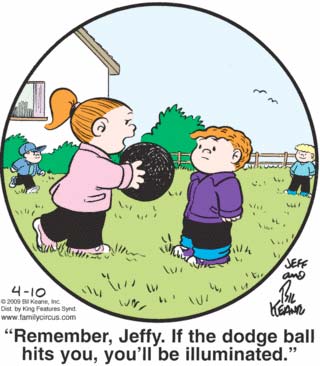
“Remember, Jeffy.  If the dodge ball hits you, you’ll be illuminated.”

– Dolly explaining the game of Dodge Ball to Jeffy.

What is wrong with this sentence?

Dotty said, “you’ll be illuminated”.  She used the wrong word; she meant “eliminate”.  The two words “illuminate” and “eliminate” sound similar which is why she confused them but they are not homonyms

Homonyms are words that sound the same or are spelled the same but have a different meaning.

The words illuminate and eliminate are not spelled the same, they do not sound the same, and they do not have the same meaning.

Illuminate vs Eliminate


Pronouncing Illuminate and Eliminate

Illuminate = Ill – lu – min – ate

Eliminate = E – li – min – ate

What do they mean?

The word “illuminate” means to shine light on something physically or metaphorically as a way to explain something. 

Physical: Please illuminate this room by turning on the lights.

Metaphorically: Please illuminate me by explaining what is happening. 

The word “eliminate” means to take something out or to get rid of.

Mixing up “illuminate” with “eliminate” is an example of malapropism.


What is Malapropism?

Malapropism is when one word is used in the place of a similar sounding word by accident because the user has confused the two words. 

A malapropism can cause confusion and humour when used depending on the context. 

Example – Literally vs Literary

Malapropism – I was literary ready to quit my job. 

Correct Word – I was literally ready to quit my job. 

Children use a lot of malapropism because they are still learning how to speak.  Even many adults, native and fluent English speakers included, will use malapropisms without realizing it. 

What is Dodge Ball?

Dodge Ball is a game that can be played in groups or teams.  The simple goal of the game is to take out the other team or the targeted people in the game by throwing a bouncy ball at them.  The other team or the targeted players literally have to dodge (miss) the ball to stay in the game. 


You win by either eliminating the other team completely or by taking out the targeted players of the game.

What did Dolly mean?

Dolly said, “Remember, Jeffy.  If the dodge ball hits you, you’ll be illuminated.”

What Dolly meant to say was, “Remember, Jeffy.  If the dodge ball hits you, you’ll be eliminated.”

Dolly’s explanation of the game Dodge Ball was an example of malapropism.

Today’s images are from herehere, here, and here.

Wednesday, November 5, 2014

Nov 5th: Remember, Remember the 5th of November

Hello everyone!

Today’s comic highlights the origins of Bonfire Night!


COMIC BREAKDOWN

“Upstairs to the Houses of Parliament”

 – Sign in the tunnel

“Planning a night to remember? Looks like it’s going to go with a bang!”

– Man dressed in red (a Guard) speaking to Guy Fawkes

What is Bonfire Night?

Bonfire Night is an annual celebration dedicated to bonfires and fireworks.  It is celebrated in the United Kingdom, many Commonwealth countries (the former British Empire) and parts of the United States.  The event takes place on the night of November the 5th.


Similar bonfire and firework traditions also exist in other European cultures and countries.

Who is Guy Fawkes?

The origins of Bonfire Night are closely tied in remembrance to the Gunpowder Plot of 1605. 

The population of England and Britain as a whole is majority Christian.  From the 1500s – 1600s Europe experienced a lot of wars and upheaval that were related to religion.  Western Europe had been Catholic but starting in the early 1500s there was a split in Christian worship and the Protestant faiths of Christianity began.  Populations and whole countries were very divided over their religious beliefs. 

In the 1500s, England (today part of the United Kingdom) became a Protestant country and Catholics were not treated well.  However there were still many English Catholics.  Originally the ruler had promised religious tolerance but this was never a reality.


The Gunpowder Plot of 1605 was an attempt by a group of English Catholics to assassinate the Protestant King of England and Scotland, King James I (known as King James VI in Scotland).   The plan was to blow up Parliament, Westminster, with gunpowder during the state opening of Parliament which was to take place on November 5th.  By killing the Protestant King, Catholics hoped to put a Catholic monarch on the English throne.

The Plot was discovered in late October and stopped.  Guards found a man named Guy Fawkes, a member of the Plot, guarding 36 barrels of gunpowder in the basement of Parliament at midnight on November 4th.


By 1607 celebrations started occurring across Britain to mark November 5th.  Communities would light giant bonfires and burn effigies, giant doll models of whoever they wanted to represent, of Guy Fawkes. 

Because Guy Fawkes is the most famous member of the Gunpowder Plot, Bonfire Night is also known as Guy Fawkes Night.

Note: The name Guy Fawkes is pronounced like “Guy Fox”.

For more information on Guy Fawkes and the Gunpowder Plot, read here

Today, the symbol of Guy Fawkes is used as a political and social representation by groups that feel that they are being treated unfairly.  You are probably aware of the mask that represents Guy Fawkes even if you do not know who he is.


Why is this comic funny?

This comic references that if the Gunpowder Plot had happened as planned, November 5th would be a night to really remember!  The guard has caught Guy Fawkes!

Moreover, to say that November 5th would have been a night with a big bang has a double meaning.  The use of the word “bang” in this comic is a homograph.  Homographs are words that are spelled the same, sometimes also pronounced the same, but have a different meaning. 

Bang means a loud noise, something an explosion would create, and it is also used as a word to reference something memorable.  November the 5th could have literally been a night of a memorable big bang

Happy Bonfire Night!

Today’s images are from here, herehere, here and here.

Monday, November 3, 2014

Nov 3rd: Hi & Lois – Running a Temperature

Hello everyone!

Today’s comic is Hi & Lois featuring baby Trixie. 


COMIC BREAKDOWN

“Uh oh, Trixie, you may be running a temperature.” – Lois (Mother)

“That’s impossible!  I can’t even walk yet.”  – Trixie thinking to herself

Running a temperature?  What does it have to do with walking?

The expression “running a temperature” does not literally have anything to do with the action of running or walking.  It means that someone has or is developing a fever. 

A fever is when one has a higher than average body temperature.  This means that Trixie is getting sick and her temperature is higher than normal. 


Because Trixie is a baby she takes the meaning of “running a temperature” to be literal and is therefore confused as to what her mother is saying.  Trixie understands that she is sick but does not realize her mother just used a popular expression to describe when one is sick with a high temperature, a fever. 

Today’s images are from here and here.